Recently 8-year-old domestic worker Zohra was tortured to death by her employer. Exposing another case of exploitation of domestic worker, Police arrested three women on charges of forcing a housemaid into prostitution, torturing her and shaving her head. Cases of brutality against domestic workers highlighted in every few months. Remember the cases we see in the mainstream media is only a tip of an iceberg, thousands of cases go unreported in our society.
Millions of women and girls are working as domestic helpers in Pakistan. Most of the domestic workers are making sacrifices to support their families. Instead of giving them respect, they deserve they are among the most exploited and abused workers. In domestic workers lower and middle age girls are most vulnerable who face physical and mental torture, sexual abuse, rape and even death.
If we talk about the employer or abuser it could be a male or female, adult or a child, from a middle-class family or high-class family, influential or a common man. What do these people have in common? cruelty and sick mentality.
Let’s dig out the core reasons for this brutality. First of all, people, who have enough money to afford a housekeeper they tend to get underage or adult girls from the villages because they think they can buy anything with money. They consider and deal with them as their slaves. Feudal mindset and patriarchy are the most common reason of violence but in this case psychology and mental health of the abuser also counts. The cruel actions of employers portray the sadistic tendencies and ill mental health. It has become common practice that people let their frustration and anger out to the nearest weaker person. We have seen many cases where one family member is beating the domestic worker brutally and other family members are watching or even recording it in mobile which shows the overall mental state of the society.
In society today, mental illness and violence are often seen as inextricably linked, creating a harsh stigma for people which have dire consequences. Violence has serious implications for society and people who are involve in it needs to be studied. We need to understand the factors contributing to violence so that we can appropriately develop a risk management plan. Addressing the factors and finding solutions can eliminate violence from the society.
The culture of sending children as domestic helpers in other cities become one of the most significant reasons for abuse because the victims have no contact with their families. Many face illegal confinement and torture for months and years until they escape dead or alive. The families of the victims are also culprit because most of the time they know that their children are facing violence and they never take action to get them out. Many of them remain silent because of fear because they get threats by the influential owner. Others remain quiet because they are getting paid and after knowing about the violence, they get hush money to remain silent. In many cases, the victim is physically and sexually abused by the employer but remain silent sometimes in fear and sometimes she also gets some benefits in exchange for it.
Most cases are not reported but if reported, most of the time culprit do not get punishment. Most of the time they work out an agreement with the victims’ families or they use loopholes of law to get free. Legal proceeding and affording high lawyer fee end up costing a lot to the poor families which is also a reason that they do not register the case or withdraw it.
We as a society are responsible for these kinds of incidence too. We do not take action and remain silent when we see any kind of violence in society. We do not condemn the people around us involved in violence and cruelty. We protest for a few weeks, now even for a few hours on social media making the trend #1 on twitter and questioning humanity and saying how can someone be so ruthless and cruel. But suddenly the hype dies down and we get back to our lives waiting for another incident to become a hero on social media through demanding justice for another victim.
Your introduction, who are you and what do you do?
Well, my name is Omer Aftab, you can call me a social entrepreneur and a human right activist.
I started White Ribbon Pakistan more than a decade ago with an idea to create awareness about the deeply penetrated issue of violence against women and girls in our society. I can fairly say that White Ribbon brought the concept of working on the mindset and behavioural change of the perpetrator (mostly men in our country) rather than preaching to the victims who are already suppressed.
How has the pandemic contributed to domestic violence? Are there more cases than before?
No doubt, the world has seen an exponential rise in the curve of domestic violence during the pandemic. In Pakistan domestic violence both physical and mental has aggravated since the pandemic began.
In Pakistan, it is hard to measure that to what extent domestic violence is aggravated by the pandemic and lockdown because it is happening behind closed doors and it has a long history of under-reporting.
Due to the lockdown, the world has experienced a serious problem of providing access/relief to the victims. Various strategies have been adopted to bring legal access and support to the victims. Even in Pakistan, the Government has widely promoted its helpline so victims can get legal aid across Pakistan.
White Ribbon feels that mental health is a serious issue which causes the increase in domestic violence, we foresee that in the coming months the situation might get more serious due to increase in unemployment, financial burden, and frustration of adjusting to the new normal.
Are there any stats you know?
We do not have any official data regarding the last quarter, but we have witnessed and referred many cases where mental health and marital issues are on the top.
How do you think we can help victims in this situation?
The objective of the White Ribbon is to engage men in the dialogue from all walks of life and create an enabling environment, where not only women are standing at the front line to guard the victims. If we put this into action, it means that we encourage society to create a support system where any form of violence is unacceptable by whosoever.
COVID 19 is new to all of us, even the perpetrators. At this time, we can engage the stakeholders, Police, medicolegal, lawyers and organisations who are working to protect the victims to be more vigilant and quicker in action. We can’t stress enough on the fact that an individual’s support system is the biggest protection, and first to call for protection.
Encouraging women to stand up against any form of violence and asking men to endorse this ideology is the key step to support our women who stuck at home.
What is the solution according you in this situation?
To solve these kinds of issues, family, friends and neighbours of the victim should take action and support the victims of domestic violence. This is a testing time for everyone, and frustration levels are high, but none of this can excuse causing harm to another person. So, break the silence to end domestic violence and pledge today never to commit, excuse and remain silent about violence against women.
We focus on men’s role in preventing violence because Men can play a significant role in ending violence against women. Men can influence the results by changing their behaviour and convincing others to stop violence against women too. We need to curb the destructive beliefs, patriarchal mindset and expectations about what it means to be a man, the ultimate cause of violence against women. Working with men and boys can offer alternative models of masculinity and manhood, which reject gender violence and build respect for women and girls.
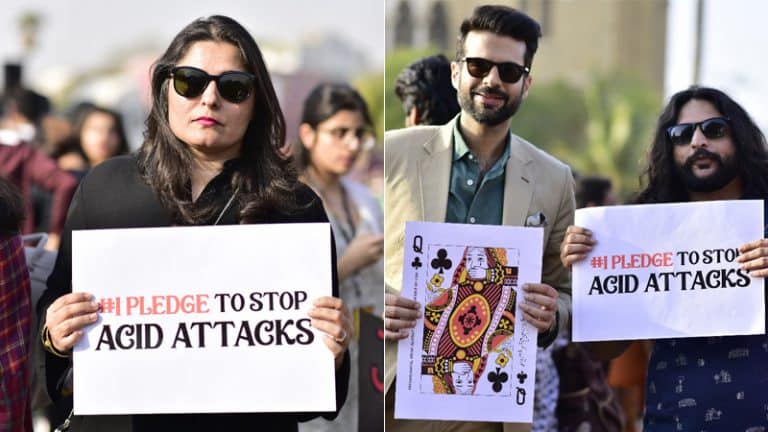
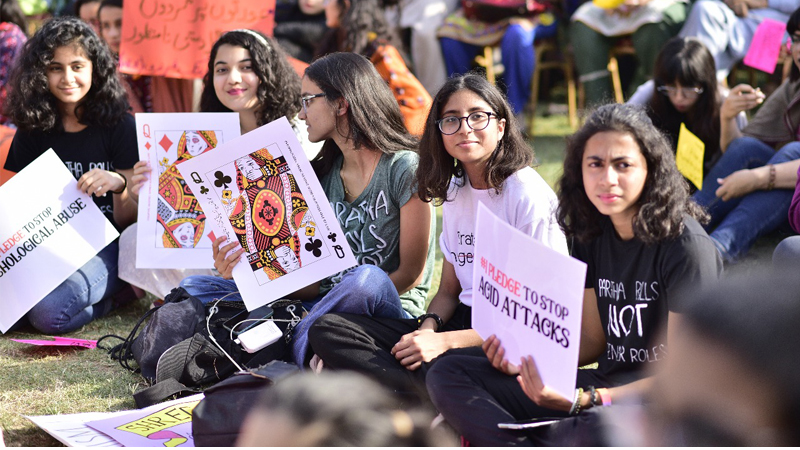
White Ribbon Pakistan, a social sector organisation has resorted to an unorthodox approach to raise awareness about ending violence against women by launching playing cards with moral messages printed on them.
White Ribbon Pakistan, a social sector organisation working for gender equality, has resorted to an unorthodox approach to raise awareness about ending violence against women by launching playing cards with moral messages printed on them, a press release states. Each of the four Queens in the deck has been illustrated to depict a different form of abuse i.e. acid attacks, honor killings, psychological abuse and physical abuse.
These cards are being distributed by influential women, celebrities and social workers at different places like chai dhabbas, snooker and gaming clubs, road side cafés and tuck stops
On the side of these 4 cards, there are informational messages both in Urdu and English. These cards are being distributed by influential women, celebrities and social workers at different places like chai dhabbas, snooker and gaming clubs, road side cafés and tuck stops. The ‘Queens Campaign’ intends to not only spark conversation around the topic, but also inform men of the laws on women protection.
In Pakistan, every 5th woman is subjected to physical violence with 80% of the total women population suffering this abuse. About 40 percent of all married women go through domestic violence in their lifetime.
Each of the four Queens in the deck has been illustrated to depict a different form of abuse i.e. acid attacks, honor killings, psychological abuse and physical abuse
White Ribbon is working with a different approach to counter the issue of violence against women by addressing the patriarchal mind-set of individuals, society and state; and spreading awareness about the consequences of domestic violence.
Speaking at the eve of the launching ceremony of the campaign, Chief Executive Officer of White Ribbon, Omer Aftab said, “One issue with most communication campaigns on domestic violence is that the media is either ignored or doesn’t reach the target market. In an effort to connect directly with its intended audience, White Ribbon used a highly innovative medium that has never been utilized before.”
The first step to end the violence against women is to recognize the root causes of this menace. Gender-based discrimination, social norms, cultural practices and gender stereotypes perpetuate the violence against women. There are many ways to end violence such as prevent it before it happens, empowering women, educating society by promoting gender equality and changing norms and values, making strict laws, implementation and enforcement of the laws by giving appropriate punishment to the culprits and men engagement on different levels.
Prevent it before it happens
Preventing before it happens means educating our next generations regarding gender equality and gender discrimination which is a long term process. As we know that values and norms around gender equality are forged from childhood to adulthood. We should start educating children from early life and promote respectful relationships and gender equality among young boys and girls. Educating children to avoid gender stereotyping and false norms that promote gender inequality. Involvement of youth ensures the faster, sustained progress on preventing and eradicating gender-based violence.
Empowering women
We have to promote gender equality, women’s empowerment and the human rights of women. We will have to make public and private spaces safer for women, ensure their economic independence, security and increasing women’s participation and decision-making powers in all fields of life. Researches have proven that an educated and empowered woman is less likely to be the victim of abuse.
Making effective laws
An additional approach to reduce violence is to pass and implement effective laws and policies against the culprit. Legal systems and public policy frameworks have often overlooked the crisis of violence against women. Social bias and cultural norms protect the perpetrators from punishment and still a crime like domestic violence are considered a private matter in the eyes of common people. In Pakistan, many laws have been made to protect women against violence but many barriers and loopholes exist that are needed to be addressed.
Implementation and enforcement of the laws
While a historic number of laws and policies against violence are now in place, implementation is still lagging behind. Implementation of the laws strictly and across the board is crucial to put an end to the violence. Wrongdoers know the loopholes and cultural practices, they have no fear to get caught and punished which encourage them to keep doing violence. We cannot reduce the acts of violence until we give punishments to the perpetrators and make them a lesson for others.
Men engagement
There is a growing awareness that men, in partnership with women, can play a significant role in ending violence against women. Men engagement is proved to be the best practice to end the violence against women. Involvement of the men and boys accelerate the progress in ending GBV because most the time the men are the wrongdoers in this case. Men can have an important influence on reducing violence by changing their own attitudes and behavior and by intervening to prevent other men’s violence. A man can stop another man to end the violence by using authority, power and influence.
Men who have influence belonging to the different sectors like government, judiciary, and media can help in spreading awareness and mobilizing communities and they can take effective steps to curb the issue.
LAHORE: Around 60 to 70pc of women in Pakistan are suffering from some form of violence and abuse, around 5,000 women are killed every year while thousands become disabled because of domestic violence.
These figures have been revealed by the White Ribbon, an organisation which focuses on Violence against Women and Girls (VAWG), on the Day of Elimination of Violence against Women to mark the International 16 Days of Activism from Nov 25 to Dec 9.
Expressing concerns at the current condition of Pakistani women, White Ribbon CEO Omer Aftab stressed the need for immediate steps for eradication of violence against women.
“One out of every five women in Pakistan faces domestic violence and the ratio has increased alarmingly by 20pc in recent years,” he said.
Speaking at a nationwide pledge campaign launched by White Ribbon, he said the incidents of the VAWG, including domestic violence, murder, rape, child abuse, child marriages, honour killing, harassment and other anti-women cultural practices, were on the rise.
“White Ribbon is striving to end the violence against women by engaging men and boys to take the pledge: Never to commit violence, excuse it or remain silent about it. White Ribbon is actually a men’s movement to end violence against women by addressing men and the patriarchal mindset of individuals and society. We believe it is not sufficient to create awareness about women rights among the women only, men must join them; to encourage norms of consent, respect and gender equality; to challenge the unfair power relations, which promote gender-based violence,” Mr Aftab added.